
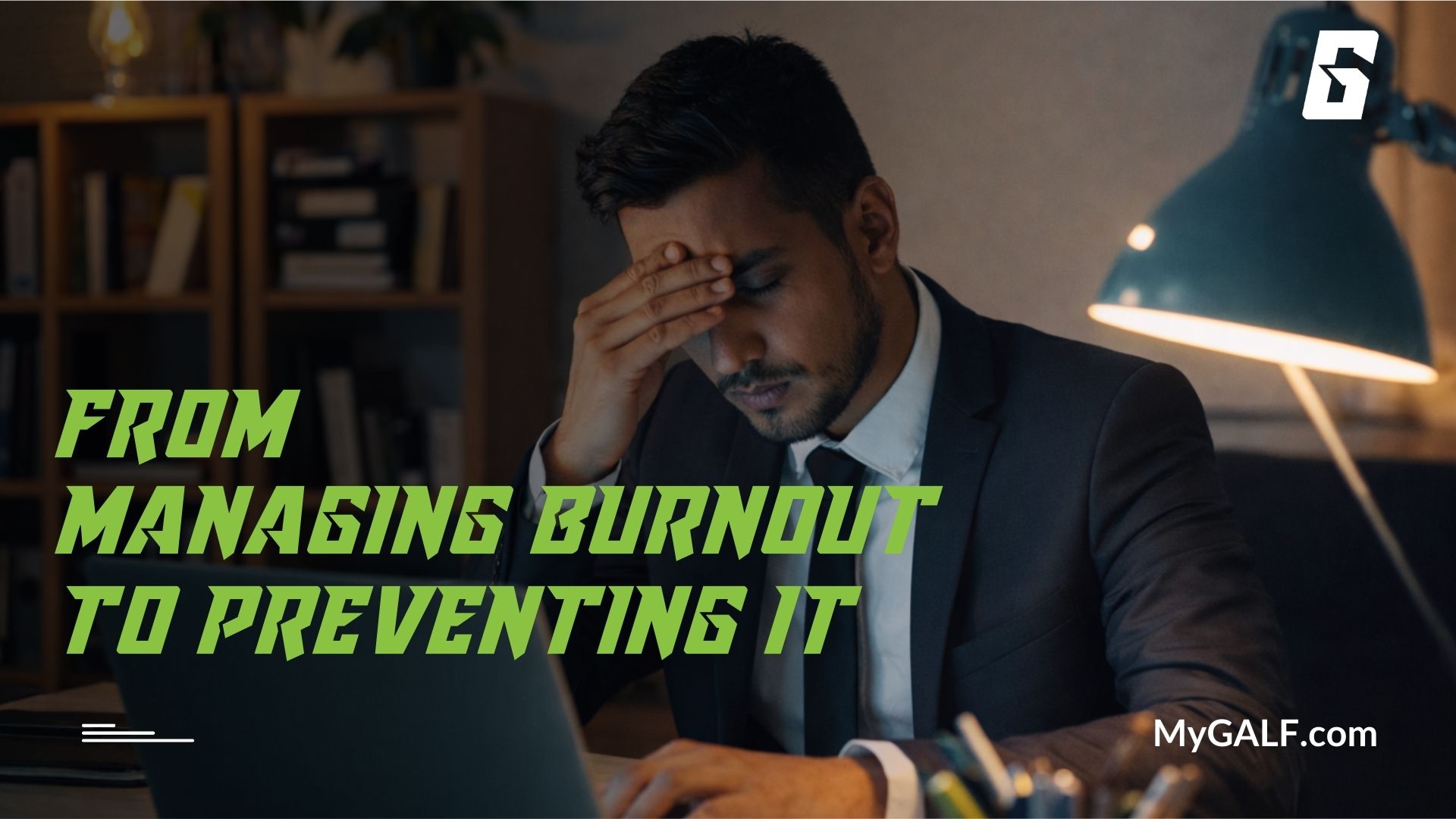
From Managing Burnout to Preventing It


Mental Wellness
By: GALF
04 Feb 2026
Businesses have seen burnout as a fire drill for a long time.
Something goes wrong. Someone trips and falls. We answer.
That way of doing things is no longer enough.
Burnout is a failure of the system, not of the person. And systems don't just need empathy. They need to be redesigned.
What the data shows about burnout in 2026
The Gallup State of the Global Workplace Report says that stress levels among workers are going up steadily.
According to Gallup: "Employees are under more stress than ever before, and engagement is still low around the world." Only 27% of managers globally are engaged at work.
Source: https://www.gallup.com/workplace/349484/state-of-the-global-workplace.aspx
Gallup also says that workers who are burnt out are: "63% more likely to call in sick and 2.6 times more likely to be looking for a new job."
Source: https://www.gallup.com/workplace/237059/employee-burnout-part-main-causes.aspx
This loss of employees costs a lot. Deloitte says that turnover and lost productivity caused by burnout are a big and growing financial risk. They say that: Poor worker health is a major cause of higher turnover, lower productivity, and higher replacement costs.
The World Health Organisation (WHO) still calls burnout
“Burn-out is a syndrome conceptualized as resulting from chronic workplace stress that has not been successfully managed. It is characterized by three dimensions:
● feelings of energy depletion or exhaustion;
● increased mental distance from one’s job, or feelings of negativism or cynicism related to one's job; and
● reduced professional efficacy.”
Source: https://www.who.int/news/item/28-05-2019-burn-out-an-occupational-phenomenon-international classification-of-diseases
What's Changed Now?
The work itself. AI acceleration, always-on collaboration, faster decision-making, and blurred lines have made many jobs that require a lot of thinking but don't give you much time to recover.
This is not a problem with resilience.
It's a problem with how the work is set up.
Trend for 2026: Designing for Energy, Not Just Output
To avoid burnout in 2026, we need to think about energy architecture, or how work uses up mental, emotional, and physical energy.
1. Cognitive Load as a Measure of Performance
Performance doesn’t decline because people stop trying.
It declines because mental capacity gets exhausted.
When workdays are packed with meetings, constant context-switching, and long hours of decision-making, cognitive load quietly builds up.
The result is familiar: higher stress, slower thinking, and diminishing output. Working longer under sustained mental effort does not produce better results. Productivity per hour drops once cognitive fatigue sets in. What looks like commitment on the calendar often turns into cognitive debt in practice.
Give This a Try
Audit one week of meetings and ask:
● What decisions were actually made?
● What moved forward because this meeting existed?
If a meeting produces no decisions, no clarity, and no next steps, it isn’t alignment. It’s an energy drain.
High-performing teams don’t just manage time.
They manage cognitive load.
2. Movement Is What Makes Performance Possible
Movement is often framed as a wellness extra. In reality, it is foundational to sustained performance. Long periods of physical stillness increase stress and reduce mental clarity. Even small amounts of movement during the workday help regulate energy, improve focus, and support better decision-making. T
his is why teams that perform consistently are normalising:
● Walking one-on-one conversations instead of seated check-ins
● Short movement breaks between deep work sessions
● Standing discussions for faster alignment and clearer thinking
These are not perks or productivity hacks. They are simple design choices that prevent the slow erosion of energy across the day. When movement is built into how work happens, performance stops being fragile and starts becoming sustainable.
This is why teams that do well no longer see movement as a way to improve their health. They are using it as part of their work infrastructure.
You don't have to go to the gym or change your clothes to move at work. It needs small, easy-to-follow cues built into the workday.
Normalising is what teams that keep performing do:
● Instead of sitting down for check-ins, walk 1:1s.
● Breaks for small movements between meetings.
● Implement standing decision reviews to clarify issues more quickly.
Many workplaces are quietly adding active-work accessories that make things easier and more comfortable to use:
● Resistance bands or stretch loops are kept at desks so people can quickly get back to work between calls.
● Hand grip trainers that let you move around a little while you work on a screen
● Small mobility tools that help you change your posture and get your blood flowing during long periods of focus
In the usual sense, these aren't fitness products. They are tools for managing energy that have low disruption, high frequency, and high return.
The goal isn't to "work out at work." It's to keep from being still for long periods of time, which can slowly make it harder to think clearly and control your emotions. When tools for movement are easy to see, use, and get used to, they stop being extras.
They become the norm.
And defaults are what make behavior change on a large scale.
3. From recovering from burnout to predicting it
More and more, businesses are paying attention to early signs instead of exit interviews:
● Less informal teamwork
● Less physical activity
● Patterns of delayed response
● Productivity goes up and then down again.
These are signs of burnout, not problems with engagement.
The Business Case in 2026
Gallup consistently shows that teams that are healthier have:
● Better long-term performance
● Less absenteeism
● Less turnover
Not letting burnout happen doesn't slow down growth. It makes it smoother.
The Bottom Line
Burnout management reacts to problems after they surface. Burnout prevention redesigns work so those problems surface far less often.
In 2026, leaders won’t be judged by how well their teams bounce back— but by how rarely they have to. That shift requires rethinking how work, movement, and energy coexist—especially in hybrid environments where boundaries are already blurred.
This is explored further in The Active Hybrid Ecosystem: Rethinking How We Work, Move, and Perform, which looks at how movement-led work design is becoming a performance advantage, not a wellness trend.
When work is designed to support energy, movement, and recovery, performance stops being fragile and starts becoming sustainable.
If this resonates and you’d like to understand how we can help apply it in your context, connect with us here: https://mygalf.com/contact_us